Home/Destinations/Alexandria

Egypt's Mediterranean Crown

Alexandria
Pearl of the Sea

Founded by Alexander the Great in 331 BCE, Alexandria was once the intellectual capital of the ancient world. Today it remains Egypt's most cosmopolitan city — a place where Greek columns meet Ottoman mosques, and the Mediterranean light falls on two millennia of layered civilisation.

Best Time: Mar – May & Sep – NovEgypt's Second CityUNESCO BibliothecaArabic, French & Greek heritage
5.2MPopulation
331 BCEFounded
2,350Years of History
32kmMediterranean Coastline

Where East Met West
For Two Millennia

Alexandria is the city that invented the idea of a great library — the notion that all human knowledge could be gathered in one place.

Alexander the Great founded Alexandria in 331 BCE, selecting the site himself on a narrow strip between the Mediterranean and Lake Maryut, and commissioning the architect Dinocrates to lay out its ordered grid. Under the Ptolemies it became the capital of a dynasty that would last three centuries and give the world its most famous library: the Mouseion and its hundreds of thousands of scrolls, a lighthouse — the Pharos — that stood among the Seven Wonders of the Ancient World, and Cleopatra VII, the last and most brilliant of her line, whose court on the eastern harbour commanded the most powerful city between Rome and the Persian Gulf.

The Arab conquest of 642 CE shifted Egypt's political centre to Fustat, but Alexandria endured as the gateway of the Mediterranean. By the nineteenth century, under Muhammad Ali, it was reborn as the most cosmopolitan city in the Arab world: Greeks, Italians, Jews, Syrians and Egyptians trading, intermarrying and building an elegant, European-inflected cityscape along the Corniche. This Alexandria — vivid, melancholy and multilingual — was the city that C.P. Cavafy, the great Greek poet, recorded in his verse, and that Lawrence Durrell mythologised in his four-volume Alexandria Quartet, a meditation on desire, memory and the dissolution of empire.
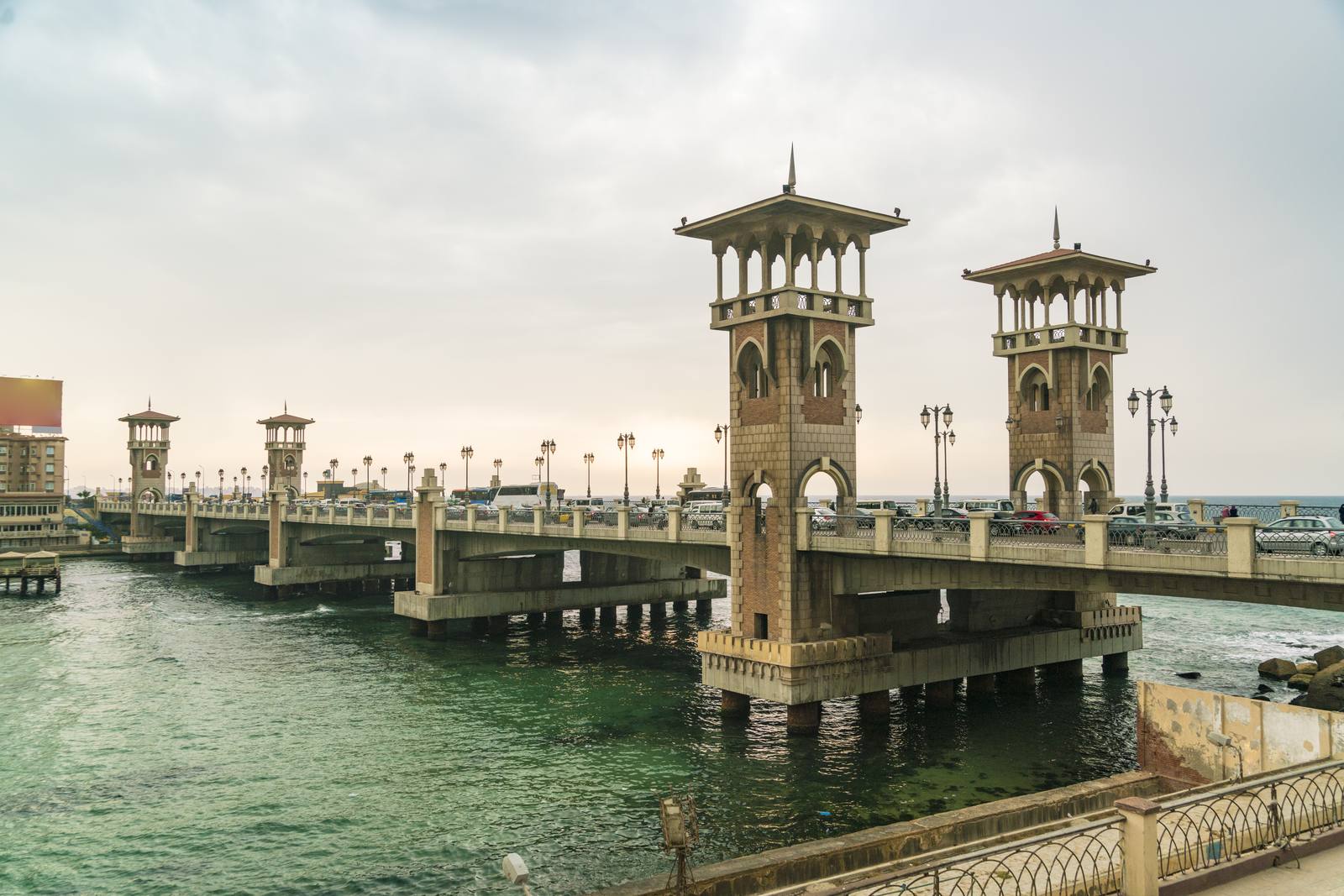
The Stanley Bridge and Alexandria Corniche at dusk

Two and a Half Millennia
of Unbroken Story

  • 331 BCE

    Alexander the Great Founds Alexandria

    Alexander chose the site personally on a strip between the Mediterranean and Lake Maryut. The city's grid was designed by the architect Dinocrates — a rational, ordered plan that would make Alexandria the most efficiently planned city in the ancient world.

  • 285 BCE

    The Great Library Opens

    Under Ptolemy II, the Mouseion and Library of Alexandria become the world's first research institution, housing up to 700,000 scrolls. Euclid, Eratosthenes and Archimedes all worked here. The Pharos Lighthouse is completed in the same era — one of the Seven Wonders of the Ancient World.

  • 48 BCE

    Cleopatra's Court

    Julius Caesar arrives in Alexandria. Cleopatra VII, last of the Ptolemies, rules from the Royal Quarter on the eastern harbour, commanding the most powerful city in the Mediterranean world. The fate of Rome and Egypt is decided on these shores.

  • 642 CE

    The Arab Conquest

    Amr ibn al-As captures Alexandria after a fourteen-month siege. Egypt's intellectual capital shifts to Fustat but Alexandria remains the Mediterranean gateway — its harbour still the busiest point of contact between the Arab world and Europe for centuries to come.

  • 1798 CE

    Napoleon's Expedition

    French forces land at Alexandria, beginning the modern era of Egyptology. The city's cosmopolitan revival follows under Muhammad Ali, who transforms Alexandria into a modern Mediterranean port with grand boulevards, cotton exchanges and mixed-nationality communities.

  • 1900–1960

    The Golden Age

    Alexandria becomes the summer capital of Egypt and the most diverse city in the Arab world, home to Greeks, Italians, Jews, Syrians and Egyptians living in elegant harmony. Immortalised by C.P. Cavafy's poetry and Lawrence Durrell's Alexandria Quartet, this era remains the city's defining myth.

Eight Wonders of
Alexandria

Bibliotheca Alexandrina tilted disc facade with world scripts01
Ancient Wonder Reborn

Bibliotheca Alexandrina

Opened 2002, the modern Library of Alexandria is a deliberate echo of the ancient wonder. Its tilted disc roof, engraved with 120 world scripts, houses 8 million books, four museums, four galleries and a planetarium. One of the great works of contemporary architecture — and a living monument to the idea that all knowledge belongs to everyone.

Citadel of Qaitbay medieval fortress by the Mediterranean sea02
Mamluk Fortress

Citadel of Qaitbay

Built 1477 on the exact site of the ancient Pharos Lighthouse, one of the Seven Wonders of the Ancient World. Stone from the collapsed lighthouse was recycled into its walls. The harbour views alone justify the visit.

Pompeys Pillar ancient Roman granite column in Alexandria03
Roman Monument

Pompey's Pillar

A 27-metre Aswan granite column erected in 297 CE — the tallest ancient column outside Rome. Surrounded by Serapeum ruins and two Ptolemaic sphinxes. The name is a medieval misidentification; it actually honours Emperor Diocletian.

Syncretic funerary art from the Catacombs of Kom el-Shoqafa04
Underground Necropolis

Catacombs of Kom el-Shoqafa

Discovered in 1900 when a donkey fell through the ground. Three levels of 2nd-century tombs blending Egyptian, Greek and Roman funerary art. The finest example of syncretic art in the ancient world — a literal underground fusion of civilisations.

Montaza Palace and Gardens Alexandria royal palace seaside grounds05
Ptolemaic Palace Site

Montaza Palace & Gardens

The summer palace of the last Egyptian royal family, set in 150 acres of gardens on the eastern Mediterranean shore. The Salamlek and Haramlek palaces are now luxury hotels. The gardens are Alexandria's most beloved public park — a green escape from the city's intensity.

Alexandria National Museum artifacts of ancient Egypt06
Greek-Roman Museum

Alexandria National Museum

Housed in a restored Italian palazzo, its three floors trace Alexandria's story through Pharaonic, Greek, Roman, Coptic and Islamic artefacts. The Graeco-Roman collection is one of the finest in existence.

The four domes and minaret of Abu Abbas al-Mursi Mosque rising above Anfushi07
Islamic Heritage

Abu Abbas al-Mursi Mosque

Built 1775 over the tomb of the 13th-century Andalusian saint Abu Abbas al-Mursi. The most beautiful mosque in Alexandria, with its four domes and elegant minaret rising above the Anfushi waterfront. A spiritual focal point of the city for 250 years.

Alexandria Corniche and Stanley Bridge at golden hour08
City Experience

The Corniche & Stanley Bridge

Alexandria's 26km seafront corniche is the city's living room. At Stanley Bridge, the art deco arches frame a view that has appeared on a thousand postcards. Walk it at sunset when the Mediterranean turns copper and the city's full melancholy beauty comes alive.

"Alexandria is not a city. It is a state of mind."
E.M. Forster — Novelist, 1922

When to Visit
Alexandria

14°
Jan
15°
Feb
18°
Mar
22°
Apr
26°
May
29°
Jun
31°
Jul
31°
Aug
29°
Sep
25°
Oct
20°
Nov
16°
Dec
Best season (Mar – May & Oct – Nov)
Shoulder season
Peak heat — sea breeze helps

March to May offers perfect Mediterranean warmth at 18–26°C with long days and minimal crowds. October and November are equally sublime — clear skies and a golden quality of light that painters have chased for centuries.

Alexandria Climate at a Glance
Winter (Dec–Feb)14–16°C
Spring (Mar–May)18–26°C
Summer (Jun–Aug)29–31°C
Autumn (Sep–Nov)20–29°C
Annual Rainfall~180mm
HumidityModerate
Time ZoneUTC+2

What Alexandria
Tastes Like

01

Sayadeya

صيادية

Alexandria's signature fish-and-rice dish. A whole sea bream or Red Sea bass baked over a bed of deeply caramelised onion rice, scented with cumin and coriander, finished with a rich golden onion sauce. The dish of the Mediterranean fishing quarter — born on the docks and refined over generations.

Fish Market Restaurant, Alexandria Corniche
02

Hamam bi Freekeh

حمام بالفريكة

Stuffed pigeon with green wheat (freekeh), the Alexandrian version of this classic. The freekeh absorbs the pigeon juices during roasting, creating a smoky, nutty stuffing unlike anything in Cairo. A dish reserved for honoured guests and celebratory tables.

Kadoura Restaurant, Bahary
03

Molokhiya bi Samak

ملوخية بالسمك

Alexandria's coastal twist on Egypt's national green soup: the jute-leaf broth is built on a fish stock base rather than chicken, making it lighter and more marine. Served over rice with fried mullet on the side — the sea in a bowl.

Mohamed Ahmed Restaurant
04

Ful Medames Alexandriani

فول اسكندراني

The Alexandrian preparation of Egypt's national breakfast adds lemon, quality olive oil, tomato and green chilli in proportions that make it noticeably brighter and more Mediterranean than the Cairo version. Simple, ancient and irreplaceable.

Any traditional fuul shop, El Ibrahimiyya district
05

Alexandrian Kofta

كفتة اسكندرانية

The local version mixes beef with lamb and adds a higher ratio of fresh herbs and a pinch of cinnamon, giving it a distinctly fragrant character. Grilled over charcoal and served with tahini and flatbread — the perfume of a thousand Alexandrian evenings.

Al-Farouk Restaurant, Smouha
06

Basbousa Alexandriana

بسبوسة اسكندرانية

The semolina cake, but the Alexandrian version uses rose water and tops each square with a blanched almond and a drizzle of apricot jam. Lighter and more perfumed than the Cairo version — a reminder that the Greeks and the Mediterranean left their mark on even the sweetest corners of this city.

Patisserie Athineos, Raml Station

Culture, Customs
& Practical Tips

The Coffee House Culture

Alexandrian cafes (ahawi) are institutions. Sit at a marble table, order tea or Turkish coffee, and understand that time here moves at a different pace. The Trianon and Athineos cafes have been doing this since 1905 — order slowly and stay as long as you like.

The Corniche Walk at Night

Alexandrians promenade the corniche every evening regardless of season. Join them after 9pm for the authentic experience: families, lovers, fishermen, and the Mediterranean breathing in the dark. The city reveals itself in these unhurried evening hours.

Dress for a Mediterranean City

Alexandria is more relaxed than Cairo but still conservative inland. On the beaches of Montaza or Stanley, international resort norms apply. In the city centre and at mosques, cover shoulders and knees. The city rewards those who dress thoughtfully.

Friday Rhythm

The city slows significantly on Friday morning. The Great Mosque of Abu Abbas fills to overflowing for noon prayer. Markets and some restaurants close 12–2pm. By late afternoon, the corniche is packed with families — the best time to see Alexandria as its residents know it.

Photographing the Corniche

The Stanley Bridge and Corniche photograph best at golden hour (one hour before sunset) and at blue hour (20 minutes after sunset). The reflection of the bridge arches in the water is the city's signature shot. Come prepared — it rewards patience.

Greek and Italian Legacy

Look for it everywhere: the art deco apartment buildings, the French-named patisseries, the churches of different rites, the family names. This cosmopolitan layer is fading but has never fully disappeared — it is the ghost that gives Alexandria its particular melancholy.

The Land of
Alexandria

🌊

Mediterranean Shoreline

Alexandria sits on a narrow limestone strip between the Mediterranean Sea to the north and Lake Maryut to the south. The city is essentially a long, thin coastal settlement — 32km of seafront but rarely more than 6km wide. The sea defines everything: the light, the food, the mood and the memory.

🏔

The Nile Delta's Edge

To the east, Alexandria merges with the Delta's westernmost arm. The landscape becomes flat agricultural land — the richest farmland in Egypt — punctuated by canals and palm groves. A stark contrast to the city's Mediterranean drama and a reminder that the Nile underwrites all of this.

Below Sea Level

Parts of Alexandria's ancient city now lie 6–8 metres below sea level and 8 metres below the current sea floor. The submerged Royal Quarter — including Cleopatra's palace — can be explored by scuba divers and has been the subject of major archaeological expeditions since the 1990s.

Alexandria
on the Map

ALEXANDRIA
Begin Your Journey

Ready to Walk
Cleopatra's City?

Our Alexandria itineraries uncover the submerged Royal Quarter, the backstreets of the Greek Quarter, the finest seafood on the Mediterranean coast, and the melancholy grandeur of a city that once held all the world's knowledge.